The battle for your living room has never been more intense. If you are looking to invest in a premium television, you’ve likely run into two dominant acronyms: OLED and QLED. While they look similar on paper, the technology under the hood offers vastly different experiences.
In this guide, we will ask that Which is Better OLED vs. QLED and break down the fundamental differences using two of the industry’s heavy hitters: the Samsung S90F (OLED) and the Samsung QN90F (Neo QLED).
1. The Core Technology: Organic vs. Quantum Dots
The difference between these two isn’t just a single letter; it’s how they handle light.
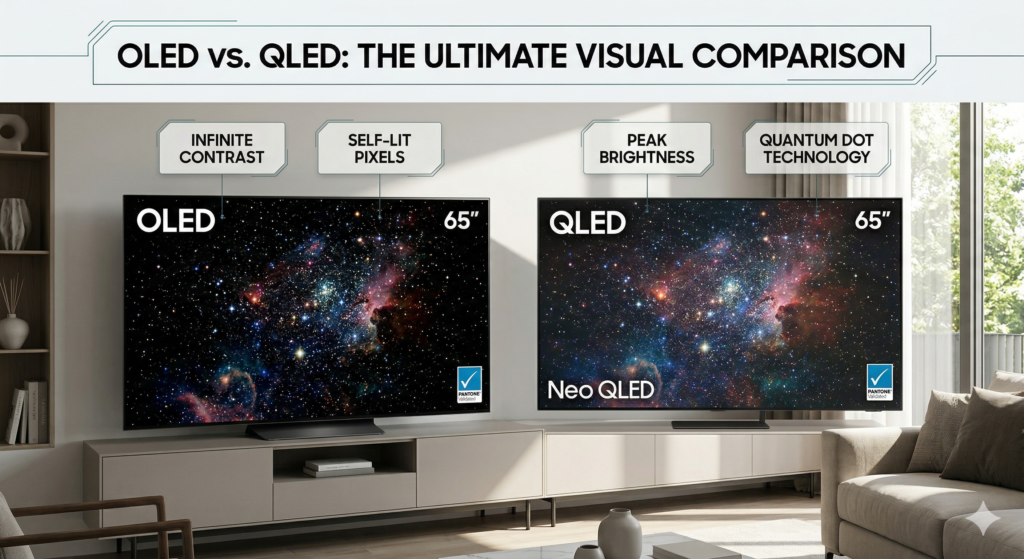
OLED (Organic Light Emitting Diode): Every single pixel is self-lit. When electricity hits the organic material, it glows. To create black, the pixel simply turns off completely.
QLED (Quantum Dot LED): These use a backlight (usually Blue LEDs) that passes through a layer of “Quantum Dots” to create colors. While they don’t turn off individually like OLED, high-end models like the QN90F use Quantum Mini LED Pro to dim specific zones with incredible precision.
2. Contrast and Black Levels: The “Perfect Black” Factor
When it comes to dark scenes, OLED is the undisputed king. Because pixels can turn off entirely, you get infinite contrast.
The “Halo” Effect: On many LED TVs, a bright object on a dark background (like a moon in the night sky) creates a blurry glow around it. Because OLED shuts off the surrounding pixels, this effect is non-existent.
However, modern Neo QLEDs have closed the gap significantly. By using Mini LEDs that are 1/50th the size of traditional LEDs, the Samsung QN90F achieves deep blacks that rival OLED while maintaining incredible detail in the shadows.
3. Brightness: The Champion of Sunlit Rooms
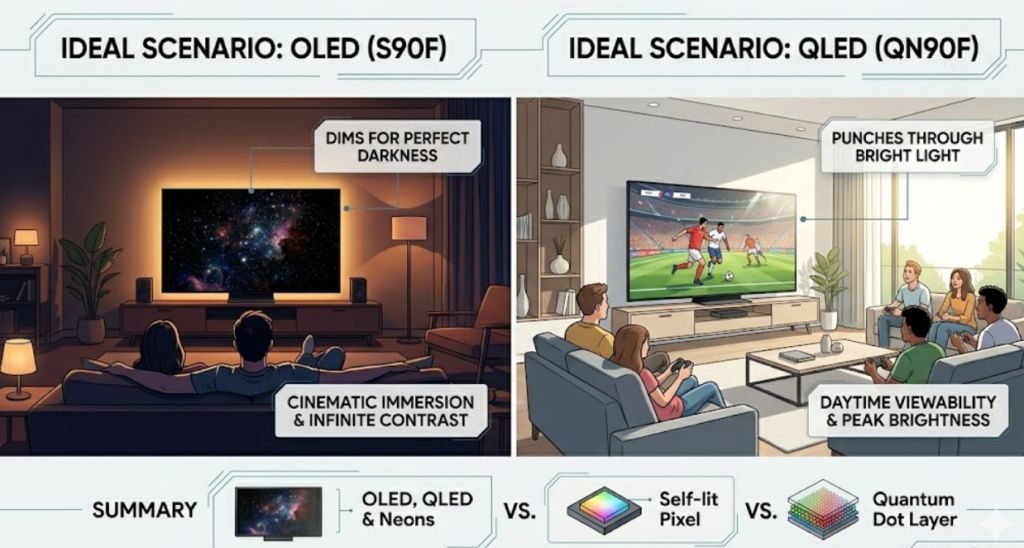
If your living room has large windows or bright lights, QLED is your winner.
QLED TVs can reach much higher peak brightness levels than OLEDs. While OLEDs have improved (the S90F is 30% brighter than its predecessor), they still use Automatic Brightness Limiters (ABL) to protect the organic panel. In a head-to-head “Sunlight Test,” the QLED’s vibrancy remains punchy and visible, whereas the OLED might appear slightly dimmed in a very bright room.
4. Gaming Performance: Speed vs. Precision
Both the S90F and QN90F are monsters for gaming, featuring FreeSync Premium Pro and AI-driven processing. But they cater to different types of gamers:
The OLED Advantage: Response time. OLED pixels change color almost instantaneously, resulting in zero motion blur. If you want the smoothest motion in fast-paced shooters, the 144Hz S90F is elite.
The QLED Advantage: Refresh rate and peace of mind. The QN90F supports up to 165Hz when connected to a PC. Furthermore, gamers who leave static HUDs (like health bars) on the screen for 15 hours a day generally prefer QLED to avoid any theoretical risk of “burn-in.”
5. Reflections and Longevity
Samsung has equipped both models with top-tier anti-reflective coatings. The QN90F (QLED) holds a UL-verified “Glance-Free” certification, making it arguably the best TV on the market for handling direct glare.
Regarding burn-in, while modern OLEDs have “self-healing” software and pixel-shifting tech to prevent permanent damage, QLED remains the naturally more “durable” tech for static content (like news tickers or security camera feeds).
Summary: Which One Is For You?
Feature
Winner: OLED (S90F)
Winner: Neo QLED (QN90F)
Movie Night
⭐ (Infinite Contrast)
Bright Living Rooms
⭐ (Peak Brightness)
Color Accuracy
⭐ (Pantone Validated)
⭐ (Pantone Validated)
Extreme Gaming
⭐ (Instant Response)
⭐ (165Hz Refresh)
Choose the OLED (S90F) if:
You are a “Cinephile.” You prefer watching movies in a dimmed or controlled lighting environment and crave that “inky” black look and perfect contrast.
Choose the Neo QLED (QN90F) if:
You have a bright, sunlit room, or you are a hardcore gamer/power user who wants the highest possible brightness and zero worries about panel longevity.
When considering the situation in the context of the details above, it is convenient to state that choosing the appropriate best smart TV is a complicated mission. This task is because different brands accompany many options, and it is up to customers to decide which they need. Samsung, LG, and...
Presentations play a significant role in our lives, appearing in various areas, especially in business and education. Because of this, people are often curious about which presentation software is the best. There are many presentation programs available in the market, each offering different features. Therefore, the choice of presentation software...
With the advancement of technology, our homes are becoming smarter. Smart TVs, smart home appliances, and in recent years, smart speakers have emerged. Google introduced the relatively affordable and compactly designed Google speakers in the past years. In this article, we’ll take a brief look at the Google Nest Mini,...
Google quietly introduced the new model of the long-awaited Pixel 8 series after the I/O 2024 event. The model in question, the Google Pixel 8a, as expected, managed to attract attention with its features, price, and design. So, what are the features and price of the recently released Google Pixel...
In the world of smartphones, two operating systems dominate the market: iOS, developed by Apple Inc., and Android, developed by Google. Both platforms offer unique features and functionalities, catering to different user preferences and needs. In this article, we’ll dive into various aspects of iOS and Android to help you...
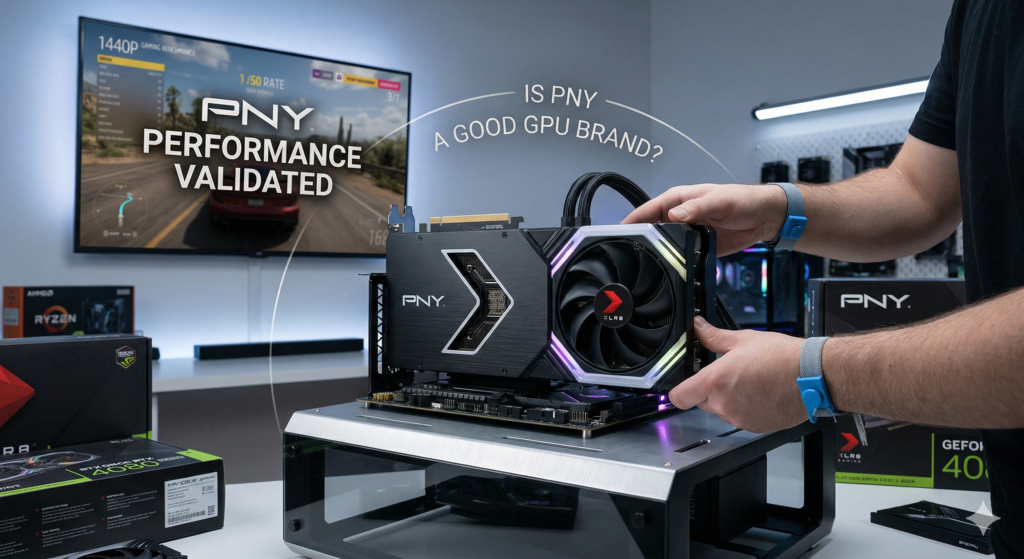
If you’re building a PC in 2026, you’ve likely noticed PNY cards sitting at competitive prices next to giants like ASUS or MSI. But the question remains: Is PNY a good GPU brand, or are you sacrificing quality for a lower price tag? From the entry-level Verto to the premium...